Cuban Refugees Would They Do It Again
Non all of the migrants hoping to claim asylum in the United States are fleeing Cardinal America's violence-torn "Northern Triangle" of Guatemala, Republic of honduras and El salvador, contrary to popular perception.
Of the 71,021 aviary-seekers waiting in Mexico for their applications to be processed in the U.S. every bit of late February, 16% were Cuban, co-ordinate to federal immigration information.
That makes Cubans the third-largest group of migrants, merely ahead of Salvadorans, and after Guatemalans and Hondurans.
Why Cubans flee
The Cubans at America's doorstep are mostly economic refugees. But since Cubans no longer have preferential condition over other immigrants – equally they did until former President Barack Obama stopped automatically albeit Cubans who made information technology to the U.S. – claiming asylum is now virtually their but hope of winning entry.
Cubans who can afford information technology wing to South America or hire smugglers to take them to United mexican states in "fast boats" before trekking north to the U.Due south. border. Those who tin't afford to pay smugglers try to cross the Florida Straits on rafts or small boats called "balsas" – a dangerous 90-mile ocean passage.
Then far this year, the U.S. Coast Guard has picked upwards 180 Cuban "balseros" at ocean trying to reach the U.S. The number is small – but information technology's already more than iii times the Declension Guard rescues of Cubans made concluding year. Cubans intercepted at sea are returned to Cuba nether the terms of a 1995 migration understanding.
The current uptick recalls the gradual increment in rafters rescued at sea in the spring of 1994, numbers that rose exponentially that summer, culminating in the "balsero" migration crisis.
Triggered by the collapse of the Soviet Union – communist Republic of cuba's main international partner at the fourth dimension – the 1994 exodus saw 35,000 Cubans arrive in the U.South. in two months.
It was the United States' 3rd Cuban migration crisis. In 1965, some 5,000 Cubans embarked from the port of Camarioca in modest boats, landing in south Florida. In 1980, the Mariel boat crisis brought 125,000 Cuban migrants to the U.Southward. in the then-called "freedom flotilla."
These migration waves came when the Cuban economy was in crunch and standards of living were falling. All three occurred when Cubans had few avenues for legal migration. With legal routes foreclosed, pressure to leave built over time equally the economic system deteriorated, finally exploding in a mass exodus of drastic people.
Later on studying U.Due south.-Cuban relations for four decades, I believe the conditions that led to these migration crises are building once once more.
Economy in free fall
Hitting by the dual shocks of renewed U.S. economical sanctions during the Trump administration and the COVID-19 pandemic, the Cuban economy shrank eleven% in 2020.
Former President Donald Trump cut off two major sources of Cuba's foreign exchange revenue: people-to-people educational travel from the U.Due south., worth roughly Usa$500 million annually, according to my assay of information from the Cuban National Office of Statistics, and $iii.five billion annually in cash remittances.
The pandemic hammered Republic of cuba's tourist industry, which suffered a 75% reject – a loss of roughly $2.5 billion.
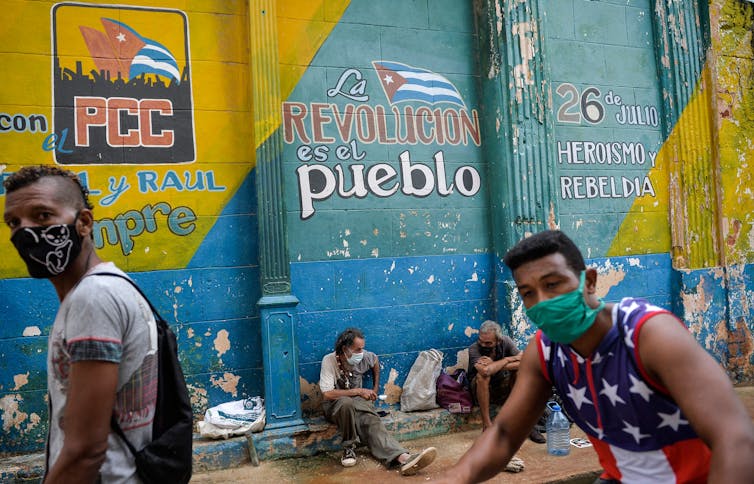
These external shocks hit an economy already weakened by the pass up in cheap oil from crunch-stricken Venezuela due to falling production there, forcing Cuba to spend more than of its scarce foreign exchange currency on fuel. Since Cuba imports most of its food, the isle nation has experienced a food crisis.
The event is the worst economic downturn since the 1990s.
Pent-upwardly Cuban demand to emigrate
The 1994 Cuban migration crisis ended when old President Neb Clinton signed an accord with Cuba providing for safe and legal migration. The U.Due south. committed to providing at least 20,000 immigrant visas to Cubans annually to avoid time to come crises past creating a release valve.
President Trump replaced President Obama's policy of normalizing U.S.-Cuban relations with one of "maximum pressure" aimed at collapsing the Cuban authorities.
He downsized the U.Southward. embassy in Havana in 2017, allegedly in response to injuries to U.Southward. personnel serving in that location. And he suspended the Cuban Family unit Reunification Parole Programme, which provided upwards of 20,000 immigrant visas annually to Cubans with close relatives in the U.S.
These measures drastically reduced the number of immigrant visas given, closing the safety valve Clinton negotiated in 1994. In 2020, only over 3,000 Cubans immigrants were admitted to the U.S.
Today, some 100,000 Cubans who have applied for the reunification program are still waiting in limbo for the program to resume.
A policy problem
The migration crunch brewing in Cuba has been largely overlooked while the Biden administration focuses on managing the rush of Cardinal American asylum-seekers and caring for unaccompanied minors at the U.S.-Mexico border.
White Firm Press Secretary Jen Psaki recently said that Cuba policy is currently under review, but that it'southward "non a summit priority."
U.S. officials could head off the migration crunch brewing in Republic of cuba by making the changes to U.Due south.-Republic of cuba relations Biden promised during his 2020 presidential campaign.
Restaffing the U.Due south. embassy in Havana would arrive possible to resume compliance with Clinton's 1994 migration agreement to grant at least 20,000 immigrant visas annually. That would give Cubans a safe and legal way to come up to the U.South. and discourage them from risking their lives on the open up seas or with human traffickers.
Lifting Trump's economic sanctions would curtail the need to immigrate by reducing Republic of cuba's economic hardship, in role by enabling Cuban Americans to send coin directly to their families there.
And reversing Trump's restrictions on travel to the island would assist revitalize the individual Cuban restaurants and bed and breakfasts that rely on U.Due south. visitors.
All these measures would put money directly into the hands of the Cuban people, giving them hope for a improve future in Cuba.
Source: https://theconversation.com/cubas-economic-woes-may-fuel-americas-next-migrant-crisis-158260
0 Response to "Cuban Refugees Would They Do It Again"
Post a Comment